


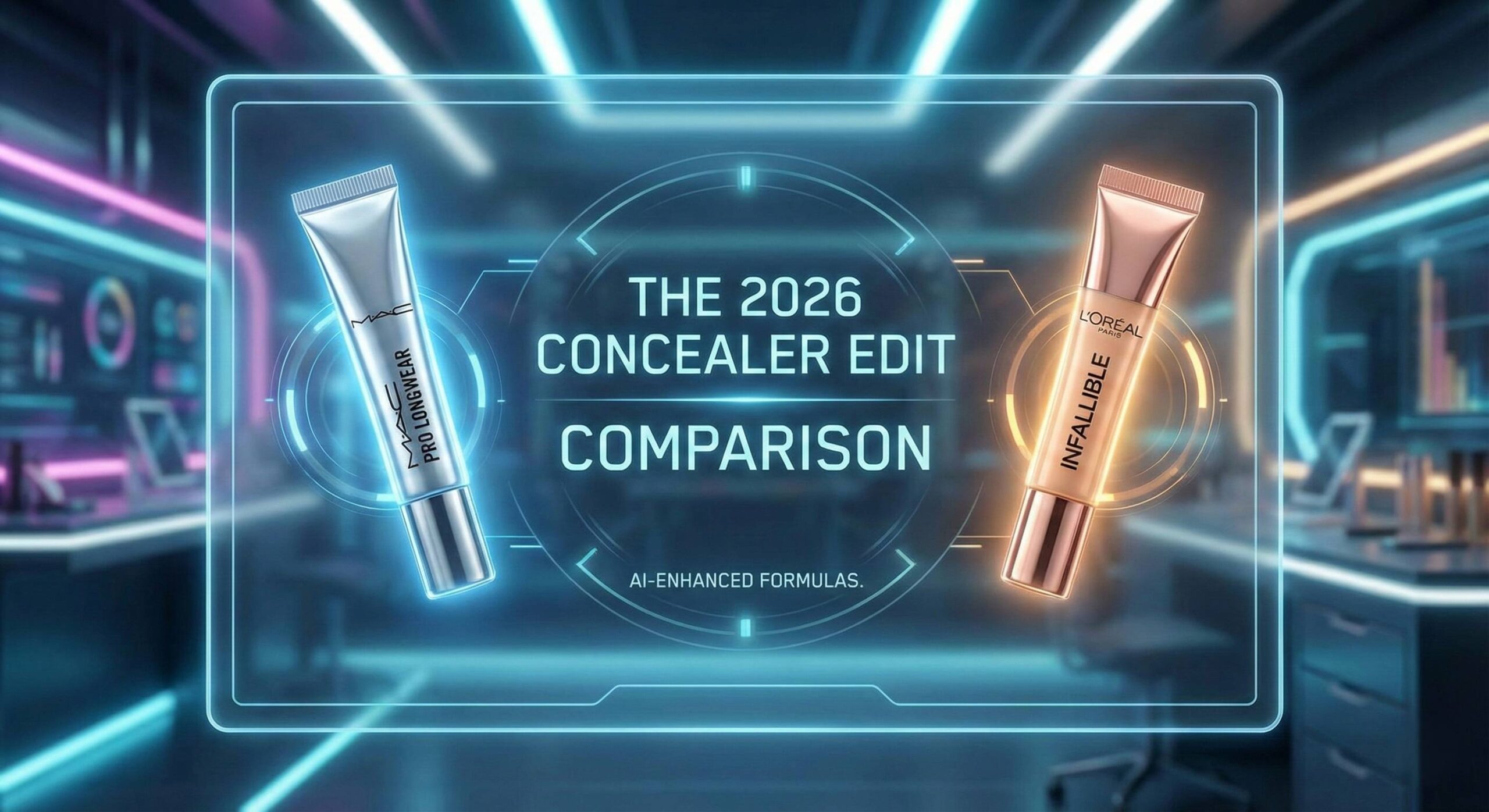
Heritage vs. Hype
In the curated vanity of the modern beauty enthusiast, few categories are as contested as high-coverage concealment. The 2026 US market landscape is defined by a sharp bifurcation: the heritage prestige formulations that prioritize stability, and the mass-market innovators engineered for immediate digital impact. Within this architectural divide, two titans stand apart: MAC Cosmetics Pro Longwear Concealer and L’Oréal Paris Infallible Full Wear Waterproof Concealer.
While social media feeds may group them together as “full coverage” staples, a deeper investigation into their chemical backbones reveals they are fundamentally different tools for different canvases. For the discerning consumer—one who scrutinizes an INCI list as closely as a shade match—understanding this distinction is paramount.
The Resin vs. The Emulsion
The defining characteristic of a luxury complexion product is often invisible: its solvent system. This is the engine that drives wear time and finish.
MAC Pro Longwear operates on a philosophy of subtraction. Its “dry” setting capability is powered by a volatile cyclic silicone matrix. Upon application, the lightweight carriers flash off rapidly, leaving behind a rigid film of Trimethylsiloxysilicate—a silicone resin renowned for its extreme hydrophobicity and transfer resistance. This is not merely makeup; it is a microscopic shield that effectively waterproofs the pigment, making it the industry standard for bridal work and high-definition media where stability is non-negotiable. For those familiar with the resilience of the Pro Longwear Concealer full coverage performance, this architectural stability is the signature “grip” that prevents migration.
Conversely, L’Oréal Infallible Full Wear represents the triumph of modern polymer engineering. It utilizes a high-viscosity, polymer-rich emulsion designed to disrupt the dominance of “full glam” concealers. Rather than the rapid dry-down of a resin, L’Oréal employs a blend of flexible acrylate copolymers and plant-derived alkanes. This creates a thicker, more elastic film that moves with the skin, offering a “fresh” and gliding sensation upon application. While this delivers immediate gratification and opacity, the physical bulk of the film can feel more substantial—almost plasticized—on the skin compared to the weightless finish of its prestige counterpart.
True Beige vs. The Warm Shift
In the editorial world, color fidelity is the ultimate luxury. A shade that shifts throughout the day compromises the entire makeup look. Here, the divergence between prestige stability and mass-market volatility becomes apparent.
L’Oréal’s formula is highly prone to oxidation, a chemical reaction where the product dries down one to two shades darker and significantly warmer than it appears in the tube. This “orange shift” is caused by the porous nature of its high-pigment load and the evaporation of its white-ish volatile solvents. Consumers must essentially “market correct” by purchasing a shade lighter than their actual complexion to compensate for this transformation.
MAC, by contrast, remains chemically stable. The resin encapsulation of the pigments protects them from immediate interaction with skin oils, maintaining the “true” color for extended durations. This reliability is why the NC/NW shade system remains the lingua franca of the beauty industry.
The Olfactory and Dermatological Profile
As the 2026 consumer becomes increasingly ingredient-literate, the “clean” credentials of a product are scrutinized alongside its performance.
MAC Pro Longwear adheres to a strict clinical standard: it is entirely fragrance-free. This omission is strategic, minimizing the risk of sensitizing the delicate periorbital skin and making it a safe choice for reactive skin types. It functions as a pure, high-performance tool, devoid of unnecessary sensory additives.
L’Oréal, however, includes fragrance and masking agents, listing potential allergens like Hexyl Cinnamal and Benzyl Salicylate directly on the packaging. While these aromatics mask the chemical scent of raw materials, they pose a risk of contact dermatitis or “burning” sensations for sensitive users. For those who prioritize skin health and barrier integrity—perhaps those who already use a gentle remover specifically for eye and lip makeup—the presence of volatile fragrance in a concealer is a significant “con” in the luxury edit.
The Vial vs. The Wand
The vessel that houses the formula tells its own story of utility versus aesthetics.
MAC’s 9ml glass vial is often criticized for its pump mechanics—specifically the high actuation force that can lead to product waste. However, from a sanitary perspective, it is superior. The hermetic seal ensures that air and bacteria never enter the main reservoir, preserving the integrity of the formula for years. It is a system designed for the hygiene-conscious artist.
L’Oréal’s jumbo doe-foot applicator is a marvel of consumer convenience, holding a massive reservoir of product for broad, “paint-like” strokes. Yet, this “dip and apply” mechanism inevitably introduces skin flora and sebum back into the tube with every use, potentially degrading the preservative system over time.
A Question of Philosophy
Ultimately, the choice between these two market leaders is not merely about price, but about philosophy.
L’Oréal Infallible Full Wear is a product of impact engineering. It offers immediate, painterly opacity and a flexible finish that suits the “instant perfection” demands of the social media age. It is a robust, budget-friendly option for those who need heavy coverage and can navigate the oxidation curve.
MAC Pro Longwear remains the product of precision engineering. Its subtractive, fragrance-free formula and resin-based stability make it the superior choice for the purist—the bride, the professional, and the consumer who demands that their concealer performs impeccably under the harsh glare of flash photography or the humidity of a summer commute. It does not merely cover; it endures.
