


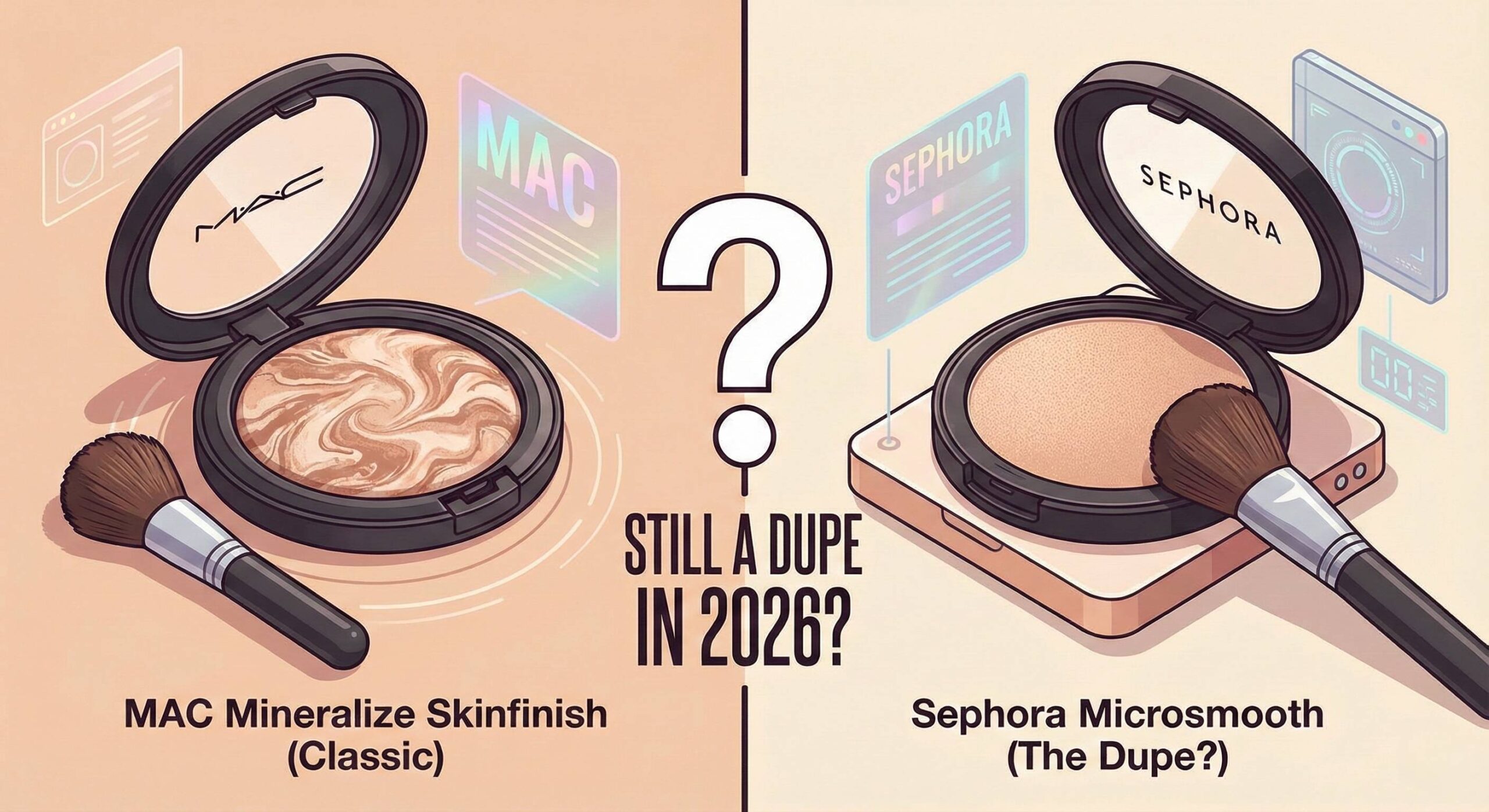
The Baked Powder Showdown
If you’ve been scrolling through BeautyTok or digging through Reddit threads anytime in the last decade, you’ve heard the legend: The Sephora Collection Microsmooth Baked Face Powder is the exact dupe for the cult-classic MAC Mineralize Skinfinish Natural.
For years, this was the ultimate budget hack. You could get that same “your skin but better,” aerated, dimensional finish for half the price. But it is 2026, and the beauty landscape has shifted. Sephora reformulated their icon to meet “Clean at Sephora” standards, while MAC stuck to its guns.
I’m here to answer one question: Is it still a dupe?
I put my wallet and my face on the line to crunch the numbers, analyze the ingredients, and wear-test these two baked giants to see if the “Save” option is actually worth it.
The Price Breakdown (Girl Math Edition)
At first glance, this looks like a slam dunk for Sephora. Why pay $44 when you can pay $22? But as any savvy dupe hunter knows, you have to look at the Price Per Gram.
Here is the receipt breakdown:
-
THE SPLURGE: MAC Mineralize Skinfinish Natural
-
Price: $44.00
-
Size: 10g
-
Cost: $4.40 per gram
-
-
THE SAVE: Sephora Microsmooth Multi-Tasking Baked Face Powder
-
Price: $22.00
-
Size: 7g
-
Cost: $3.14 per gram
-
The Reality Check: Yes, Sephora is cheaper, but the gap isn’t as massive as the sticker price suggests. You are getting 30% less product in the Sephora compact. While you still save about 29% per gram, you’ll be hitting pan way faster on the Sephora version—especially since the softer formula kicks up a lot of dust when you dip your brush in.
The Formulation (Why “Clean” Changed Everything)
This is where the dupe status starts to crumble. The original Sephora Microsmooth was a structural twin to MAC. But in the 2026 market, “Clean” is king, and Sephora removed the Talc to comply with consumer demand.
MAC (The Old Guard): MAC relies on a Talc and Dimethicone base. Talc is hydrophobic (repels water) and creates that smooth, blurring effect we love. The Dimethicone acts like a raincoat for your pigment, locking it in so humidity doesn’t melt your face off. If you are looking for that classic stability, you might want to check out a detailed mac mineralize skinfinish natural powder review to see why this formula hasn’t changed in years.
Sephora (The New Wave): Sephora replaced Talc with Mica and Nylon-12 and swapped stable mineral oils for botanical oils like Sunflower and Jojoba.
-
The Good: It feels incredibly silky and hydrating, making it a solid pick for dry skin types.
-
The Bad: Without the silicone barrier, those botanical oils are less stable. Which leads us to the dealbreaker…
The “Orange” Incident (Oxidation)
The number one complaint flooding the internet right now? The Sephora powder turns orange.
I tested this, and unfortunately, the rumors are true. Because the Sephora formula lacks the heavy silicone coating that MAC uses, the pigments get “wet” when they mix with your skin oils. When pigments get wet, they get darker and more saturated—often shifting to a warm, peachy orange.
If you have oily skin or wear a rich moisturizer, you might look in the mirror two hours later and realize your face is a different color than your neck. MAC’s formula, protected by that dimethicone shield, stays true to color for 8+ hours.
The Wear Test
I applied MAC on the left side and Sephora on the right using a fluffy brush like the MAC 129 Synthetic Powder Blush Brush to ensure an even application.
-
Hours 1–3: Both sides looked gorgeous. Satin finish, no powderiness. The Sephora side was actually a bit glowier due to the high Mica content.
-
Hour 4: The Sephora side started to break down around my nose. The “Clean” botanical oils seemed to merge with my natural oils, causing the product to slip.
-
Hour 8: The MAC side was still intact—faded, but smooth. The Sephora side had oxidized about two shades darker and looked patchy.
If you need your makeup to last through a workday without touching up, you might need to lock the Sephora version down with something heavy-duty like the Fix+ Stay Over Setting Spray to get anywhere near the longevity of the MAC powder.
Is it a Dupe?
No. In 2026, these are two fundamentally different products.
BUY THE SEPHORA ($22) IF:
-
You have dry skin and hate the feeling of powder.
-
You prioritize talc-free / clean ingredients.
-
You are willing to buy a shade lighter to account for oxidation.
-
Tip: Check the ingredient list on InciDecoder to see if the botanical oils align with your skin sensitivities.
SPLURGE ON THE MAC ($44) IF:
-
You have oily or combo skin and need oil control.
-
You are a photographer or bride (zero flashback).
-
You hate returns. MAC’s color consistency means you won’t waste money on a product that changes color halfway through the day.
Sometimes, you get what you pay for. While I love a good bargain, the risk of turning Oompa Loompa orange makes the MAC Mineralize Skinfinish Natural the winner of this battle. It’s a “Splurge” that actually saves you money in the long run because you won’t throw it in the trash.
If you prefer a fuller coverage powder foundation rather than a sheer setting powder, you might want to skip both of these and look into the Studio Fix Powder Plus Foundation instead.
Final Score:
-
MAC: 9/10 (The Heavyweight Champ)
-
Sephora: 6/10 (The Risky Contender)
