


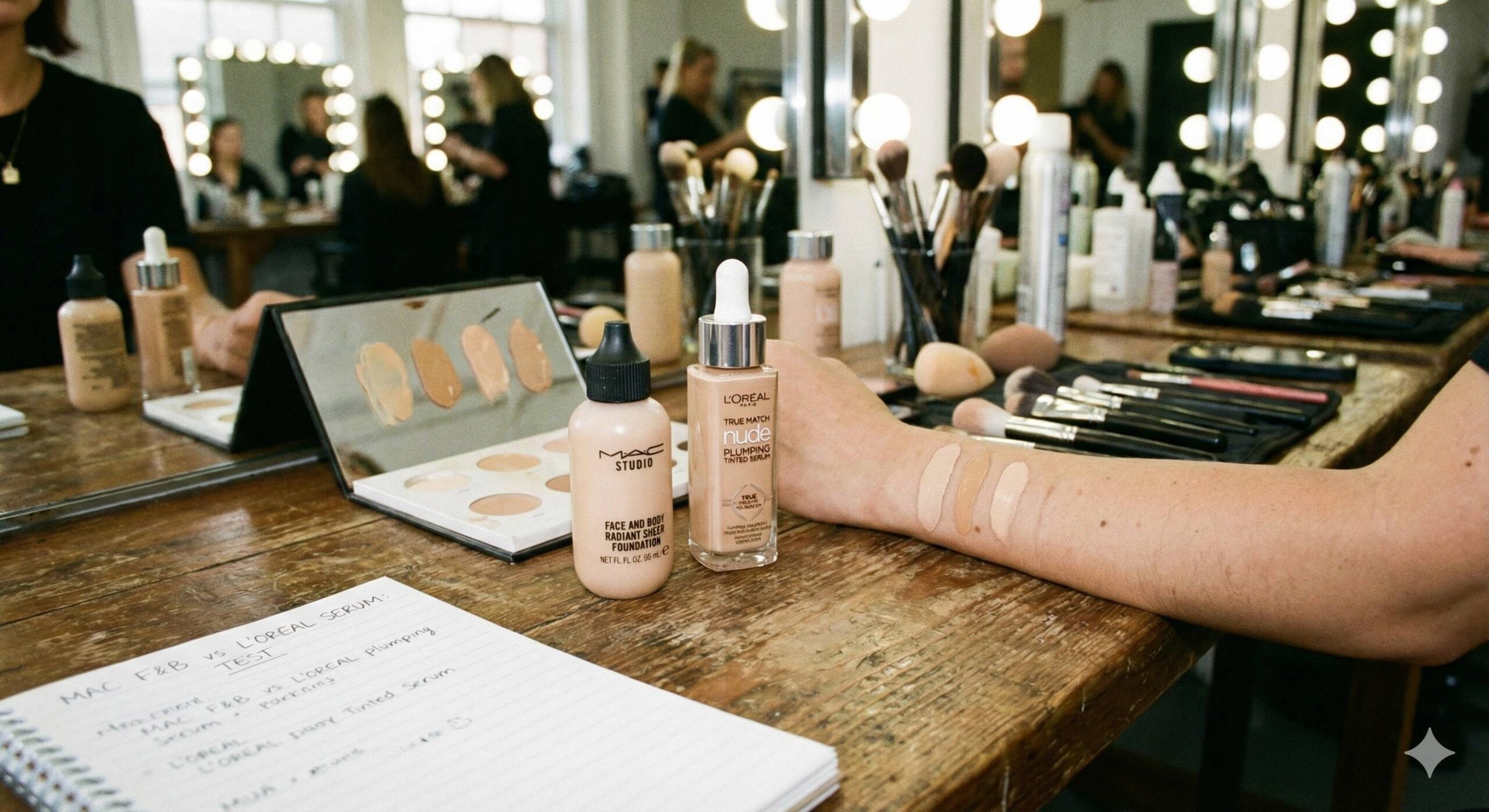
As a working makeup artist, my kit is real estate. Every ounce added to my set bag needs to earn its rent through versatility, sanitation, and absolute performance reliability under studio lights. In the 2026 landscape, where clients demand that “clean girl” skin finish with high-definition durability, the battle between the heritage pro staple, MAC Studio Radiance Face and Body, and the mass-market challenger, L’Oreal True Match Nude Hyaluronic Tinted Serum, is one I see constantly.
While TikTok might group these together as “skin tints,” chemically, they are diametrically opposed tools. One is a friction-activated polymer mesh designed for the rigors of a photoshoot; the other is a volatile solvent system built for speed. Here is the technical deep dive on which formulation actually belongs in a professional rotation.
Sanitation and Packaging Engineering
Before we even discuss the finish, we must talk about sanitation. For a pro, cross-contamination is non-negotiable.
MAC Studio Radiance remains the gold standard for hygiene. Its utilitarian LDPE squeeze bottle and precision nozzle allow me to micro-dose product directly onto a palette or the back of my hand without the dispenser ever touching the skin. The design minimizes air intake, which is critical for preserving the stability of the antioxidants and preventing oxidation.
Conversely, L’Oreal’s adoption of a glass pipette is a functional failure for a working kit. The viscosity of the serum is too low for the dropper’s diameter, causing spontaneous dripping and product accumulation on the bottle neck. This “crust” prevents a tight seal, leading to leaks in my bag and accelerated oxidation. Furthermore, a pipette encourages users to touch the dropper to the face—a massive sanitation breach that makes it disqualified for professional use unless meticulously decanted.
Formulation Physics: Friction vs. Flash-Dry
The behavior of these fluids on the skin is where the “kit staple” distinction becomes clear.
MAC utilizes a sophisticated friction-activated mesh. The formula contains amphiphilic copolymers that are unaligned in the bottle. When I rub the product between my hands (generating heat and friction), the water phase evaporates, and the polymers align into a flexible, waterproof web. This technique creates a film that moves with the client’s micro-expressions without cracking, making it ideal for long shooting days. You can read our full breakdown of this performance in our MAC Studio Radiance Face and Body Radiant Sheer Foundation review.
L’Oreal employs a volatile “quick-break” system. It relies on high-proof Alcohol Denat. and Isododecane to flash off rapidly upon application. This deposits the pigment and hyaluronic acid quickly, creating a dry-down finish that feels weightless but lacks the flexibility of the MAC polymer mesh. While the inclusion of 1% Sodium Hyaluronate is chemically significant for hydration , the high alcohol content can be counter-productive, potentially increasing transepidermal water loss on dry skin types.
For a deep dive into the implications of alcohol in cosmetic formulations, Incidecoder offers excellent data on how these solvents function as penetration enhancers.
Color Theory and Oxidation
Nothing ruins a continuity shot like a foundation turning orange two hours later.
L’Oreal True Match Nude struggles significantly with oxidation. The rapid evaporation of the solvent leaves the iron oxides exposed to air and skin sebum almost immediately. Combined with porous Perlite which can absorb oil and wet the pigment (the “wet stone” effect), the color frequently shifts darker or warmer shortly after application. This forces me to guess and buy shades lighter than necessary, which is inefficient for kit stocking.
MAC offers 30 shades using their professional C/N/W coding system, which allows for precise undertone matching. Because the pigments are encapsulated within a stable water-silicone emulsion that retains its emollients, the color you see in the bottle is the color that stays on the face. This color fidelity is why the MAC Studio Face and Body Foundation lineage has been a backstage hero for decades.
Photography Performance and Flashback
In flash photography, we look for two things: the absence of “flashback” (white cast) and the quality of the radiance.
-
MAC: Achieves radiance through emollient refraction. The oils and silicones bend light to mimic the hydro-reflectivity of healthy, hydrated skin. It reads as “skin” on camera.
-
L’Oreal: Achieves radiance through physical reflection using Synthetic Fluorphlogopite (synthetic mica). While finely milled, under hard studio flash or direct sunlight, this can exhibit micro-sparkles that look distinctly like makeup rather than skin texture.
Durability and Layering
For bridal or red carpet work, water resistance is key. MAC is officially waterproof due to the Hydrogenated Polyisobutene and copolymer matrix, meaning it beads off sweat and tears. It is also infinitely “stackable.” I can layer 3-4 coats to build coverage without it looking cakey because the layers fuse together.
L’Oreal is water-resistant but not waterproof. More importantly, the resin-based film is difficult to layer. Applying wet product over a dried layer can re-emulsify and lift the resin, causing patchiness. To lock in either product for extreme conditions, I always recommend a light dusting of MAC Mineralize Skinfinish Natural to set the T-zone without killing the glow.
The Professional Verdict
If you are a consumer looking for a quick, matte-radiant finish for a Zoom call, the L’Oreal serum is a functional “fast beauty” option, provided you account for the oxidation. However, for a professional kit, MAC Studio Radiance Face and Body is the superior technical formulation. Its friction-activated adhesion, sanitary packaging, and waterproof nature make it an irreplaceable tool for creating skin that looks like skin, not makeup.
For skin prep before application, ensuring a hydrated base is crucial; I often pair this with a lightweight primer like MAC Prep + Prime Skin to enhance the slip of the polymer mesh.
